Words

“People should regard their words as seeds.
They should sow them, and then allow them to grow in silence.
Our elders taught us that the earth is always talking to us,
but we should keep silence in order to hear her.
There are many voices besides ours. Many voices…”

“Silence”

“It has a sound, a fullness.
It’s heavy with sigh of tree,
and space between breaths.
It’s ripe with pause between birdsong
and crash of surf.
It’s golden they say.
But no one tells us it’s addictive.”

Yes, there were blueberries. Not the kind my mother brought home from the store that could not be eaten until unwrapped and properly washed and sorted, but the ones that the older kids kept secret from the younger ones as a rite of passage into the woods where only they knew the location while we had to navigate through our fears of being lost and abandoned forever despite the woods only being a few hundred feet from familiar ground. Our pride and exaltation reflected in purple tongues, stained fingers and a bag of surplus berries we now had the power to share, or not. We filled our delight and waited for the next summer rain so we might repeat the adventure, but now, it was our turn to coax the younger in while knowing for certain no witches lived among the brambles.

And the rains did come, watering our world with a deep and rich petrichor luring us back into the woods. This time our senses on high alert for the flashing sparks of saffron through the morning light accompanied by the excited shrieks of “sally – sally” – the tiny woodland salamanders destined to live out their lives in a glass jar with grass and stones by the side of the bed, or destined for science experiments in suspended animation based on the sci-fi movies of the day. And then there was the moment when you allowed yourself to gaze into each other’s eyes and all of a sudden, the veil of separateness between you and the tiny golden newt would dissolve and it no longer became possible to keep the lid sealed atop the jar, and the new found pleasure of releasing the tiny soul into the woods superseded the desire to keep him.
Tutorials

Life Practice

Life practice implies using all the knowledge and wisdom acquired during drum circle practice and transferring that to how we live our lives outside the circle. My teacher reminded us that the circle does not magically make one a better person but rather makes the person we are louder—meaning more obvious and therefore allowing for the possibility of a deeper self awareness. It is this self awareness that generates the energy for all that follows; especially within the recovery process where we tend to be so embedded in our repeated patterns and comfort zones.

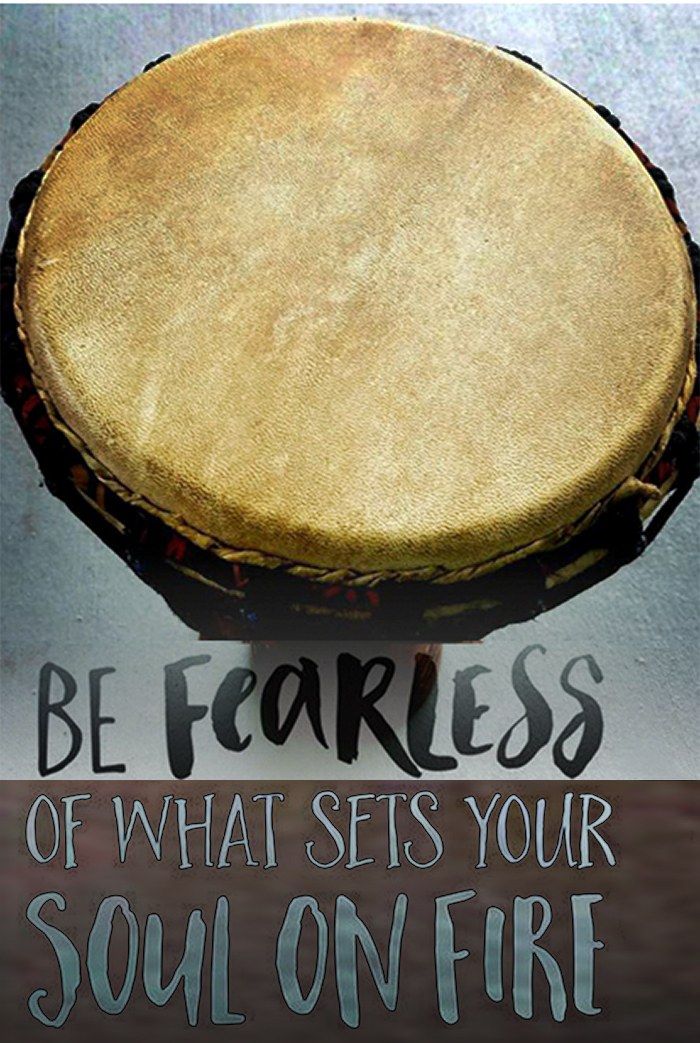
A djembe drum from above, with the words: Be fearless of what sets your soul on fire

Ethno-Musical Study

Ethnomusicology takes us into the exploration of the cultures and their approach to the language of rhythm. We explore the diversity of human life that we share on this planet and how there are many paths forward as well as many languages possible to express the quest for higher ground. We might explore traditional ways as models of living well in relationship to self and to community (whether 2 or 200). There’s also an opportunity to understand the different ways people process information and truly understand what they are hearing. One person may benefit from the language of numbers and math while another may benefit from the silent transmission of body to body while another may benefit from translating rhythm to song. As a facilitator it’s vital to recognize these differences. You do not want to be pushing the numbers while singing a song will get you there with much less stress. This process, especially as it relates to recovery, is the repeated highlighting of balance. So much of this work within the rhythm circle is about self awareness towards balance – by creating balance within oneself and then trusting to expand out into the community and towards deeper and more intimate relationships.

Free Play

The notion of free play can be a challenging facilitation. There is a paradox simply by trying to blend free with facilitation. The results can manifest with a spectrum as wide as chaos and cacophony on the one hand and a brilliant integrated and unifying improvisation on the other. So, to facilitate a circle and still allow space for individualism and creativity to flourish requires exercises and practice towards building a shared language and trust in each other, as well as releasing one’s fear of intimacy and public speaking. It primarily requires the efforts and willingness of the practitioner to find a balance that’s exemplified in the phrase—‘there is freedom in structure’ (structure—implying a deep reservoir of vocabulary, experience, intelligence, and unselfishness).

It becomes vital for the facilitator to be clear as to whether the circle’s focus is on energy and release or whether on a spiritually infused musicality.